Best Newsletter Platforms for Creators, Compared
The best newsletter platforms picked by use case: free start, paid subscriptions, selling products, and scaling a list without wrecking your margins.
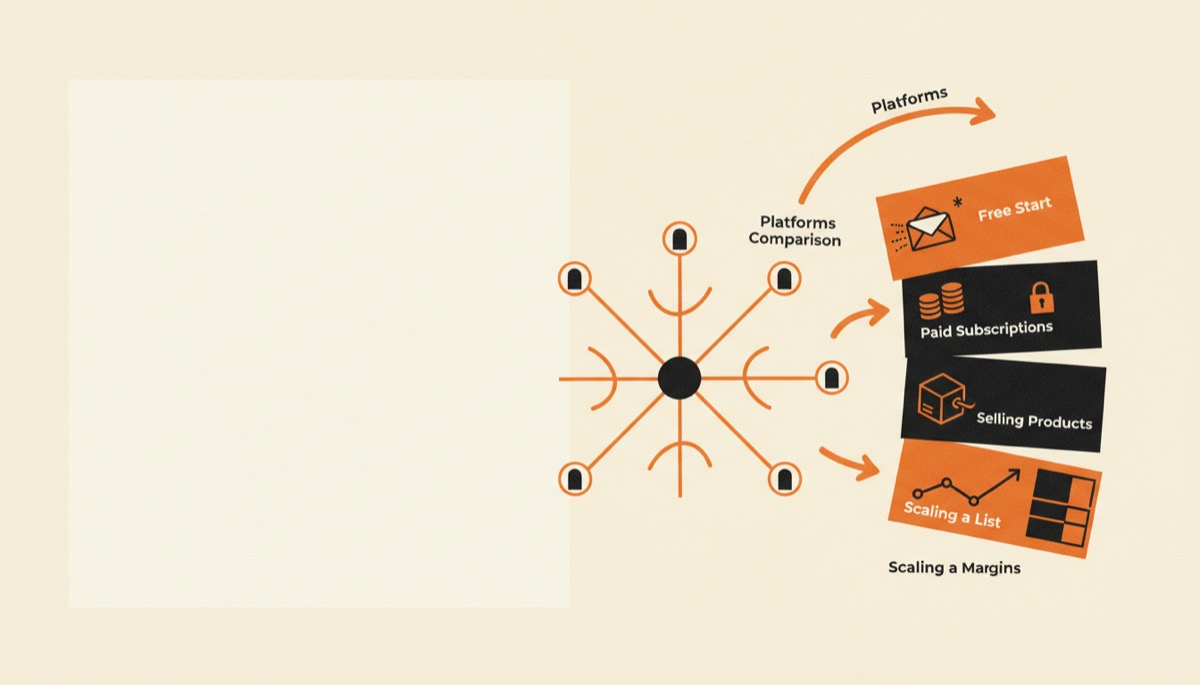
There is no single best newsletter platform, but there is a best one for each of four situations. If you want to start free, beehiiv’s Launch plan gives you the most usable product. If the newsletter is the business, beehiiv again. If email exists to sell a course or template shop, Kit. If you want maximum distribution with zero setup and do not mind the constraints, Substack.
Bottom line:
- Free start: beehiiv — free to roughly 2,500 subscribers with the publication website included.
- Paid newsletter: beehiiv again — 0% platform cut on subscription revenue.
- Selling products: Kit — the automation and segmentation a launch actually requires.
- Zero-setup distribution: Substack — free to run, but it takes 10% of subscription revenue and owns the network.
Quick comparison
| beehiiv | Kit | Substack | |
|---|---|---|---|
| Pricing model | Free Launch plan, then Scale and Max by subscriber count | Free Newsletter plan, then Creator and Creator Pro by subscriber count | No monthly fee |
| Free plan | To roughly 2,500 subscribers, publishing product intact | To roughly 10,000 subscribers, but about one form, one landing page, one automation | Unlimited, always free to publish |
| Best for | Newsletters monetized by subs, sponsors, referrals | Creators selling courses, templates, coaching | Writers who want reach over control |
| Cut of paid subscriptions | 0% platform fee; you pay Stripe processing | A platform commerce fee plus processing | 10% plus processing |
| Standout feature | Ad network, boosts, referral program, hosted website | Visual automations with real branching and tag logic | Built-in discovery network and app |
| Weakest point | Thinner funnel automation | No publishing site; price climbs at scale | You rent the audience relationship and the 10% never ends |
Prices and fees move. Verify on the beehiiv pricing page and the Kit pricing page before committing to annual billing.
Best for starting free: beehiiv
Kit’s free plan has the higher subscriber ceiling — around 10,000 versus beehiiv’s 2,500 — so this pick looks wrong until you read what each one removes.
Kit’s free tier gates you to roughly one form, one landing page, and one automation, with Kit branding on emails and no integrations. You can collect addresses. You cannot run a second lead magnet or a launch.
beehiiv’s free Launch plan leaves the actual product intact: the editor, a hosted publication website with a custom domain option, an indexable archive, subscribe forms, and analytics. What sits behind paid is monetization and scale, not basic function.
So the free plans fail in opposite directions. beehiiv gives you tools and takes away room; Kit gives you room and takes away tools. For someone publishing weekly from issue one, tools matter more. Start beehiiv free.
Best for a paid newsletter: beehiiv
If readers pay you directly, the platform’s cut is the whole decision.
beehiiv takes 0% of paid subscription revenue. You pay Stripe’s standard processing — commonly 2.9% + $0.30 — and keep the rest. Substack takes 10% on top of processing, permanently. On $10,000/month in subscriptions that is $1,000 a month you are handing over for hosting you could buy for around $100.
Kit sells subscriptions too, but charges a platform commerce fee on sales, which puts it between the two.
beehiiv also stacks two revenue channels a paywall alone does not give you. The ad network brokers sponsor placements matched to your size and niche, with reported rates around $10–30 per 1,000 engaged subscribers per send — supplementary at 1,000 readers, meaningful past a few thousand. Boosts pays you a few dollars per qualified subscriber for recommending other newsletters at signup.
Practical warning on boosts: paid-acquisition subscribers open worse than organic ones, and a padded list drags the engagement metrics that set your ad rates. Track opens by source. Our full write-up is in the beehiiv review, and pricing strategy is covered in how to start a paid newsletter.
Best for selling products: Kit
If email exists to sell a $297 course or a $47 template pack, automation beats publishing features every time, and Kit is the best automation engine in the creator tier.
The pattern that makes money looks like this: someone opts in from a lead magnet, gets tagged by interest, enters a nurture sequence, receives a pitch, and the moment they buy they are tagged as a customer and pulled out of the remaining pitch emails. That suppression step is what separates a professional launch from spamming your customers with “last chance” after they already paid.
Kit’s visual builder handles that with conditional branches, link triggers, custom fields, and time delays. Link triggers alone — “click here if you are a beginner” quietly tags and reroutes the subscriber — are the cheapest segmentation available.
Creator starts around $39/month at 1,000 subscribers, climbing with list size. That is an automation premium, and it is only worth paying if you use the automations. Details in the Kit review, and the head-to-head in Kit vs beehiiv.
Best for pure distribution: Substack
Substack costs nothing to run, has a genuine discovery network, and the reading app puts your work in front of people who have never heard of you. For essayists and commentators, that network is real value no competitor matches.
The trade is stark. Substack takes 10% of every paid subscription forever, your growth is entangled with a platform that recommends your competitors alongside you, and customization is minimal. There is no automation layer to speak of and no way to run a product launch properly.
Start there if reach is the constraint and you have nothing to sell but your writing. Move once subscription revenue makes the 10% larger than a platform fee — the arithmetic flips somewhere around a few thousand dollars a month.
Best for scaling without wrecking margins
Past 10,000 subscribers, the question stops being features and becomes cost per subscriber per send.
Three things to do before you upgrade a tier:
Prune before thresholds. Both beehiiv and Kit price by subscriber count, and beehiiv steps up at fixed points — 2,500, 5,000, 10,000 and onward. Removing people who have not opened in six months can keep you under a threshold and will improve deliverability at the same time.
Segment sends. You do not need to email the whole list every time. Engagement-based segments cut volume and raise open rates, which protects your sender reputation.
Separate the jobs. A newsletter platform for publishing and a course platform for delivery beats forcing one tool to do both. If you are choosing course software, start with the best online course platforms.
At real scale, beehiiv’s Max tier or Kit’s Creator Pro both make sense; the choice still comes down to whether you are publishing or selling.
How to choose in one minute
- Newsletter is the product, want to charge for it → beehiiv.
- Newsletter sells a course, templates, or coaching → Kit.
- Want the largest free plan and will not need automation soon → Kit free.
- Want a real publication live free this week → beehiiv free.
- Want reach above all and own nothing → Substack, and accept the 10%.
FAQ
Which newsletter platform is genuinely free?
Both beehiiv and Kit have permanent free tiers, and Substack never charges a monthly fee. beehiiv is free to roughly 2,500 subscribers with the full publishing product; Kit is free to roughly 10,000 but limits you to about one form, one landing page, and one automation.
Is Substack’s 10% cut actually a problem?
Only once you have meaningful subscription revenue. Below a few hundred dollars a month, 10% is cheaper than any paid platform. Above roughly $1,000 a month in subscriptions, a flat platform fee with a 0% take rate costs you less, and the gap widens every month you grow.
Can I switch newsletter platforms later?
Yes. Subscriber lists and tags export and import by CSV, and most platforms offer migration help including paid subscriber records so readers are not asked to re-subscribe. Automations, forms, and landing pages always get rebuilt by hand, so switch early rather than late.
Do I need a separate email tool if I use a course platform?
Usually yes, once you are running launches. All-in-one course platforms include email, but their automation is typically shallower than a dedicated tool’s. Most creators past their first product run a real email platform alongside the course host.
Start here
If you are publishing a newsletter as the business, create a free beehiiv account and send issue one this week — the free plan will carry you to your first few thousand readers.
If your list exists to sell something, start on Kit, build one opt-in and one welcome sequence, and add the branching logic when you have something to launch.
Either way, the platform is not the bottleneck. Publishing consistently is.
Tools mentioned in this article
Kit (formerly ConvertKit)
Email marketing built for creators
email newslettersTry Kit (formerly ConvertKit)Keep reading
beehiiv Review: The Best Platform for Paid Newsletters
An honest beehiiv review for US creators: the free plan, the ad network, boosts, 0% on paid subs, and the places beehiiv still falls short.
How to Start a Paid Newsletter (Step-by-Step Guide)
How to start a paid newsletter: pick a niche people pay for, choose a platform, set pricing, find your first 100 readers, and convert them to paid.
Kit Review: The Email Tool Built for Selling Things
An honest Kit review for creators: the 10k free plan and its gates, visual automations, the Creator Network, commerce fees, and who should skip Kit.
Kit vs beehiiv: Which Email Platform Should You Use?
Kit vs beehiiv compared for creators: free plans, paid newsletter fees, automation depth, growth tools, and which one fits how you actually make money.