How to Start a Print-on-Demand Business
A step-by-step plan to start a print-on-demand business: pick a niche, make designs, choose a supplier, launch a store and price for real profit.
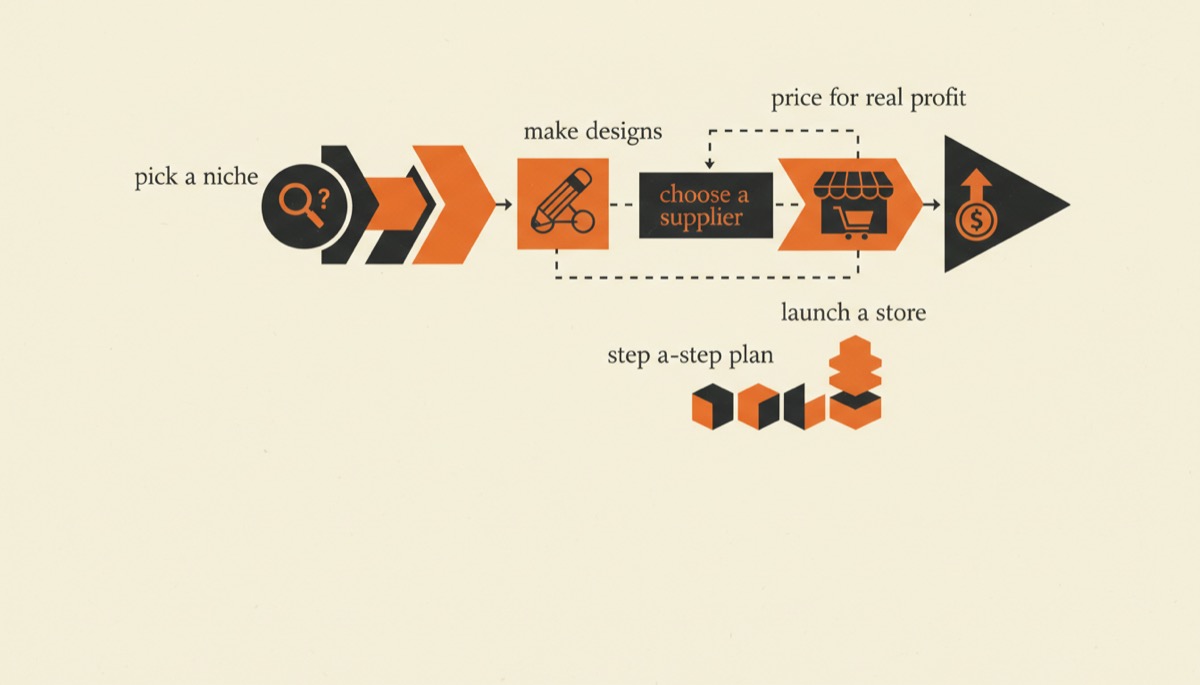
To start a print-on-demand business you need four things: a narrow niche, a handful of designs, a supplier account, and a storefront. Total cash outlay to launch is roughly $0 to $50, because nothing gets printed until someone buys. The hard part is not setup — it is picking a niche specific enough that a stranger recognizes themselves in the product.
Bottom line:
- Setup takes a weekend. Getting the first ten sales takes a month or two of promotion.
- Niche beats design skill. A mediocre design aimed at a specific identity outsells a beautiful generic one.
- Price at roughly 2.2 to 2.5 times your landed cost, then verify that number order by order.
Step 1: Pick a niche you can name in five words
The most common failure in print-on-demand is a store selling “funny t-shirts.” Nobody searches for that. People search for their own identity, hobby, job, pet, town, or inside joke.
A workable niche has three properties:
It has a name people use about themselves. Trail runners. NICU nurses. Sourdough bakers. Bassoon players. Border collie owners. If your buyer would put the phrase in their own bio, you have a niche.
It has existing demand you can see. Search the phrase on Etsy and Amazon and look at review counts, not listing counts. Reviews are proof someone paid. Zero reviews across an entire category means either no demand or a market you cannot afford to educate.
It is not dominated by licensed content. Sports teams, bands, TV shows, characters and most memes are somebody else’s intellectual property. Print-on-demand platforms reject these, and a takedown can close your store. Build on themes you own.
Narrow is safer than broad. A store for one niche with 15 products beats a store for everyone with 300.
Step 2: Make designs people wear in public
Most print-on-demand designs are text. That is fine — text-based designs sell well and are the fastest to produce — but the copy has to earn a place on someone’s chest.
What works:
- In-group phrasing. Something that reads as a joke to insiders and nonsense to everyone else. That exclusivity is the product.
- Simple, legible typography. Two fonts maximum, high contrast, readable from ten feet away.
- Restrained color. Two or three colors print more reliably than a photorealistic gradient, especially on direct-to-garment.
Technical requirements that are not optional:
- Design at the actual print size — commonly around 12 x 16 inches for a front chest print — at 300 DPI.
- Export as PNG with a transparent background. No white box behind the artwork.
- Check how the design looks on both light and dark garments before you list either.
Canva handles this comfortably. The free tier covers text-based designs and transparent exports are available on Pro, which runs around $15–$18/month depending on billing cycle. Also useful: Canva’s mockup and brand kit features keep your listings and social images visually consistent, which matters more than people expect on a marketplace.
Build a small design system rather than one-off files. Pick a font pair, a palette, and three layout templates, then generate 15 designs from them in an afternoon.
Step 3: Choose a supplier before you choose products
Your supplier determines your base cost, your quality, your shipping times, and which blanks you can sell. Pick it first.
| Printify | Printful | Gelato | |
|---|---|---|---|
| Model | Marketplace of competing print providers | In-house facilities | Local production in roughly 30 countries |
| Subscription | Free; Premium starts around $39/month | Free; Growth starts around $24.99/month | Free; Gelato+ starts around $25/month |
| Base cost | Lowest | Highest | Middle |
| Pick it when | Margin is tight, or you need a wide catalog | Branded merch for an audience that knows you | Buyers spread across several countries |
Short version: Printify for margin, Printful for consistency, Gelato for global buyers. All three are free to open and charge only when an order is placed. The full comparison is in best print-on-demand companies.
Then do the step almost everyone skips: order a sample of your best design on your chosen blank, from the exact facility that will fulfill it. It costs maybe $15–$25 and it tells you the print density, the garment weight, the true color, and how long shipping actually takes. You cannot write honest product copy or set honest delivery expectations without it.
Step 4: Pick a storefront
Three realistic paths, and they suit different people.
Etsy. Built-in buyer traffic with purchase intent, which is the single biggest advantage available to a beginner. You pay listing and transaction fees, you compete on price, and Etsy owns the customer relationship. Best first channel if you have no audience.
Shopify or another hosted store. You own the customer, the branding, and the email list. You also own traffic generation entirely, which is the hard part. Best if you already have an audience anywhere — newsletter, YouTube, Pinterest, TikTok.
An existing creator platform. If you already sell courses or templates, adding merch to the platform you are on is often the lowest-friction option, even if the store features are basic.
The suppliers all integrate with the major options and push orders automatically, sync tracking, and manage variants. Do not build a custom store. Nothing about your first POD store justifies custom development.
Step 5: Price for the landed cost, not the base cost
Here is the arithmetic that decides whether this is a business or a hobby.
Start with landed cost = base product cost + printing + shipping + platform transaction fees. A tee with a $12 base and $5 shipping on a single-item order is a $17 landed cost before Etsy or Shopify take their cut.
Then price at 2.2x to 2.5x landed cost. On that example, $38–$43 retail. That feels high until you account for returns, reprints, ad or platform fees, and the fact that you are running a business rather than donating shirts.
Three adjustments worth making:
- Fold shipping into the price and offer free shipping. Shoppers abandon carts over a shipping line item far more readily than over a higher sticker price.
- Encourage two-item orders. Additional units on the same order ship far cheaper, and this is where POD margin actually lives.
- Recheck after 20 orders. Your real average — including refunds and reprints — will not match the spreadsheet.
If the math only works at a price your niche will not pay, the problem is the product or the niche, not the pricing. Change the product.
Step 6: Get the first ten sales
Nothing about print-on-demand generates traffic on its own. Pick one channel and work it for 60 days.
Pinterest is the best fit for most POD stores. It is a search engine, pins last for months, and products photograph well in mockups. Design pins at 1000 x 1500 px with the promise in large text, and point them at product or email-capture pages. Our Pinterest playbook covers the mechanics.
Etsy SEO if you listed there. The title, the first two tags, and your review count do most of the ranking work. List 15–25 products so the shop has surface area, not three.
Your existing audience if you have one. A single honest post explaining why the product exists outperforms a month of cold advertising.
Do not run paid ads until you know your real conversion rate and margin per order. Advertising a product with unverified unit economics is how people lose money at speed.
Expect a slow start. A store that makes zero sales in week one and eight in month two is normal, not broken.
FAQ
How much does it cost to start print-on-demand?
Realistically $0 to $50. Supplier accounts are free, Canva has a free tier, and Etsy charges a small per-listing fee. The only genuine cost is the samples you order — and skipping those is the most expensive saving in this business.
Do I need an LLC to start?
Not to make your first sales in most cases, though rules vary by state and country. Many sellers start as a sole proprietor and form an entity once revenue is consistent. This is general information — confirm with a CPA or attorney for your situation.
How long until a print-on-demand store makes money?
Plan on 60–90 days of consistent listing and promotion before reliable sales, and six months before the numbers are stable enough to forecast. Stores that quit typically quit in week three, before any channel has had time to compound.
Should I sell on Etsy or my own store?
Etsy if you have no audience — it supplies the traffic. Your own store if you do, because you keep the customer and the email address. Many sellers run both, using Etsy for discovery and their own store for repeat buyers.
Start here
Open a free supplier account and build the first five designs this week. If margin decides viability, start with Printify. If the merch represents a brand people already follow, start with Printful. Build the designs and mockups in Canva.
Then order one sample before you list anything. That single habit separates the stores that survive from the ones that collect one-star reviews.
Tools mentioned in this article
Keep reading
Best Print-on-Demand Companies for Creators
The best print-on-demand companies compared on margins, print quality and global shipping, with a clear pick for each type of creator store.
Gelato vs Printful: Best POD for Global Shipping?
Gelato vs Printful for international selling: local production networks, shipping times, customs, product range, and which one fits your order map.
Printify vs Printful: Which POD Partner Is Better?
Printify vs Printful on margins, print quality, shipping speed, branding and support. Which print-on-demand partner fits your store and your budget.