How to Start Selling Online Courses, Step by Step
A practical plan to start selling online courses: validate the topic, pre-sell before you record, pick the right platform, and land your first student.
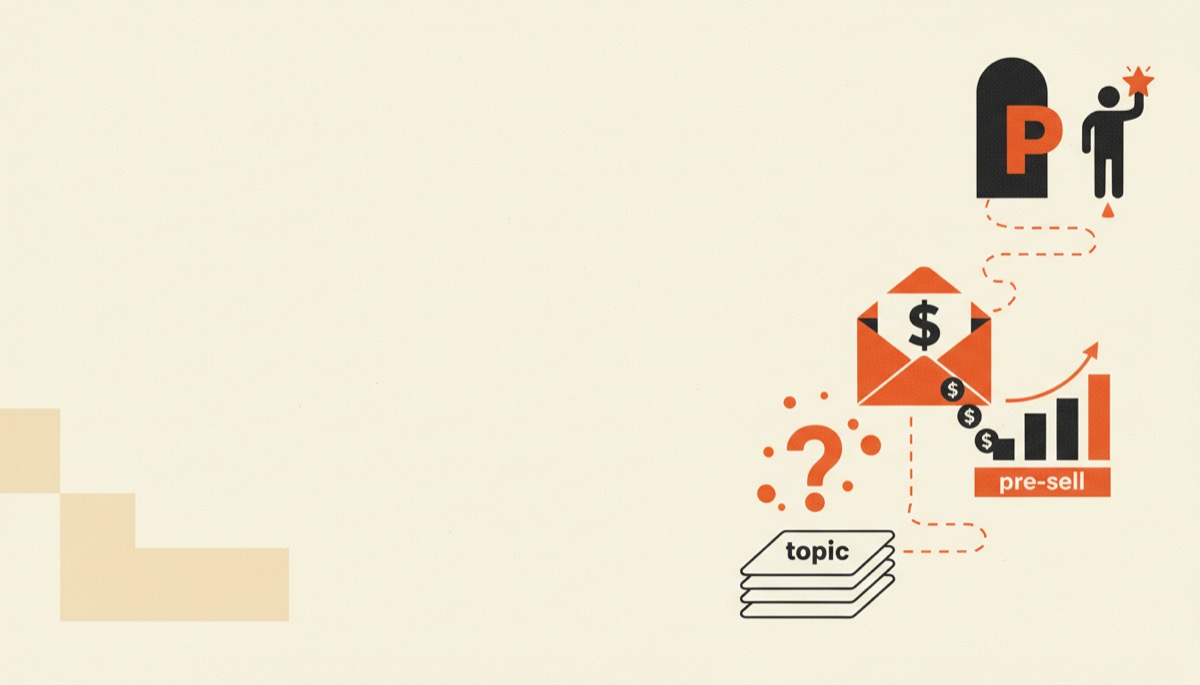
Most people who want to start selling online courses do the steps in exactly the wrong order. They record forty lessons, then look for buyers. The order that works is the reverse: find the buyers, take their money, then build the thing they paid for.
Bottom line:
- Validate the topic with conversations, not surveys. Pre-sell before you record a single lesson.
- Build the email list in parallel from day one. The list is the asset; the course is the product.
- Start on free or cheap tools. Upgrade only when a limit blocks a specific thing you are trying to do.
Step 1: Pick a topic someone is already paying to solve
The test is not “am I passionate about this.” The test is “is money already moving here.”
Look for three signals. People in your world ask you the same question repeatedly. Someone else already sells a paid solution — a course, a coach, a service, a book. And the outcome is specific enough to put a price on: “get your first ten freelance clients,” not “improve your career.”
Competition is a good sign, not a bad one. An empty market usually means no market.
Narrow harder than feels comfortable. “Photography” is not a course. “Shoot and edit product photos for your Etsy shop with a phone” is a course, and it is one you can price at $149 because the buyer can see the return.
Step 2: Talk to five potential buyers
Not a survey. Five actual conversations, fifteen minutes each, with people who match your buyer.
Ask what they have already tried, where they got stuck, what they searched for, and what they have paid for in this area. Write down their words. Those words become your sales page.
You are listening for a specific stuck point, not general interest. General interest never converts. “I bought two courses and still cannot get the lighting right” converts.
If you cannot find five people to talk to, you do not have an audience yet, and that is the real problem to fix first.
Step 3: Pre-sell before you build
This is the step people skip and the step that matters most.
Write a one-page offer: who it is for, the outcome, what is included, the price, and a start date three to four weeks out. Put a checkout on it. Tell twenty to fifty people directly — email, DMs, your existing audience, the five people you interviewed.
If five people buy, build it. If nobody buys, you just saved yourself two months of recording and learned something concrete about your positioning.
Offer a founding-member discount to make it fair: they get in cheaper and get direct access to you while you build. That is not a gimmick, it is a genuinely better deal for early buyers.
For this stage you want a landing page and a checkout, nothing more. Systeme.io does both on a genuinely free plan with no transaction fee taken out of your sales, which means your validation stage costs $0 and you keep the revenue. Three funnels, a course area, and a custom domain are included at no cost — more than enough for a pre-sell page.
Step 4: Build the email list in parallel
Every week you spend on the course and not on the list is a week where your launch audience does not grow.
Make one small free thing tied to your paid outcome: a checklist, a template, a five-minute teardown, a swipe file. Put it behind an email opt-in. Point everything you publish at it.
Send those subscribers something useful every week or two while you build. By launch day you want a list that already knows your voice, not a cold list you shout at once.
Kit is the standard pick here for creators who sell products. Its free plan covers a real amount of list growth — landing pages, forms and broadcasts included — and the paid tier adds the automations you will want once you have a product to sell on autopilot. If your business is the newsletter itself rather than the course, our Kit vs beehiiv comparison covers that fork in the road.
Step 5: Outline the course backwards from the outcome
Start with the finished state. What can the student do at the end that they could not do at the start?
Then list the steps to get there in order. Group the steps into four to six modules. Inside each module, each lesson does one job and nothing else.
Cut anything that is interesting but not on the path. A course that delivers one outcome in three hours beats a course that delivers general education in twenty. Completion rates matter because completed courses generate the testimonials that sell the next hundred.
Write one sentence per lesson before you record anything: “by the end of this lesson the student will have X.” If you cannot write that sentence, the lesson does not exist yet.
Step 6: Record without buying gear
Screen recording plus your voice is a legitimate format for most skills-based courses. Your phone in decent daylight is fine for anything you have to demonstrate physically.
Rules that actually improve quality: record in a quiet room, get the microphone close to your mouth, stand up, and do not script word for word. A rough take with clear audio beats a polished take with echo. Audio quality is the one thing students genuinely notice.
Batch the work. Record all lessons in a module in one sitting, then edit them in another. Switching modes constantly is why courses take four months instead of four weeks.
Keep lessons under ten minutes. If a lesson runs past that, it is two lessons. Our roundup of the best AI video tools for course creators covers the editing and captioning tools that cut this stage down the most.
Step 7: Choose the platform
Only now does this decision matter, and it is easier than the internet makes it sound.
Staying free while you validate: deliver the course inside Systeme.io. One course is included on its free plan and there is no transaction fee. It is basic — no quizzes, no certificates — but it delivers video lessons to paying students, which is the job.
Ready for a real course platform: the two default picks are Thinkific and Teachable.
Thinkific gives you unlimited published courses on every paid plan and a strong course builder, with plans that start around $40 to $54 a month depending on billing. Note that its long-standing free plan was retired in favor of a 30-day free trial, so use the trial rather than planning around a permanent free tier.
Teachable starts lower, around $29 to $39 a month, and is the faster of the two to get a first product live. The catch to know before you pick it: its entry plan carries a transaction fee of around 7.5% on top of normal card processing, which disappears on the higher tiers. On a $200 course that is roughly $15 out of every sale, so do the arithmetic against the cheaper monthly price.
Teachable vs Thinkific works through that tradeoff in detail, and our best online course platforms roundup covers the rest of the field if neither fits.
Confirm current prices, fees and free-trial lengths on each pricing page before committing — all of these platforms restructure their tiers periodically.
Step 8: Price it for the outcome
Price against the value of the result, not against the hours of video. A course that gets someone their first paying client is worth more than one that teaches a software feature, regardless of length.
Sensible starting bands: $47 to $97 for a focused skill, $197 to $497 for a course with a measurable business or career outcome, $1,000-plus only when live support or coaching is included.
Do not launch at $17. You will need a hundred sales to make it worth the work, and cheap buyers ask more questions than expensive ones.
Offer one payment option and at most one alternative — full price, or two or three installments. More options reduce sales.
Step 9: Run the launch
A working launch to a small list is four to six emails over five to seven days, not one announcement.
Open by naming the problem in the buyer’s own words. Then show what the course covers and who it is for. Then handle the two objections you already heard in your interviews. Then a case or example. Then a closing email with the deadline, and one final short email on the last day.
Have a real deadline: price goes up, bonus expires, or cohort closes. A launch with no deadline converts at a fraction of the rate.
Expect a conversion rate of roughly 1% to 3% of a warm list on a first launch. Five hundred subscribers at $197 and a 2% conversion is about $2,000. That is a normal, successful first launch, and it is enough to justify building the second one.
Step 10: Turn the launch into a system
After the first launch, do three things in this order.
Collect results. Ask every student what changed for them, in their words, and ask permission to quote it. Testimonials with specific outcomes are the highest-leverage asset you will ever gather.
Fix the two weakest lessons based on where students stalled.
Then automate the sale. A simple evergreen sequence — free thing, five to seven emails, offer — runs in the background while you build the next product. This is where a proper email platform earns its subscription, and where Kit’s automations pay for themselves.
Traffic comes last, not first. Once the funnel converts, feed it. Pinterest is unusually effective for digital products because pins keep sending traffic for months — see Pinterest marketing for digital products for that playbook.
FAQ
How long should my first course be?
Two to four hours of video across four to six modules is plenty. Length is not the product; the outcome is. Short, finishable courses produce better testimonials, which sell the next launch.
Do I need an audience before I start?
You need about fifty people who might buy, not a large following. That can be an email list, a professional network, a niche community you participate in, or clients you have already served. If you have none of those, build the list first and the course second.
What is the cheapest way to launch a course?
Free landing page and checkout on Systeme.io, free email plan for list building, screen recording with your existing computer. Total software cost of zero until you are making sales, then reinvest into a proper course platform when the limits start to bite.
Should I pre-sell a course that does not exist yet?
Yes, as long as you are honest about it. Give a clear start date, offer a founding-member price, and refund immediately if you fail to deliver. Pre-selling is the only reliable way to know the offer works before you spend two months building it.
Start with step three
The plan is not complicated. Pick a narrow outcome, talk to five buyers, write a one-page offer, and put a checkout on it this week.
The fastest zero-cost way to do that is a free funnel and checkout on Systeme.io plus a free email list on Kit. When five people have paid you, then go choose between Thinkific and Teachable and build the real thing.
Tools mentioned in this article
Thinkific
Course platform with a 30-day free trial and generous starter tier
course platformsTry ThinkificKit (formerly ConvertKit)
Email marketing built for creators
email newslettersTry Kit (formerly ConvertKit)