ThriveCart Review: Is the Lifetime License Worth It?
An honest ThriveCart review: how the lifetime license compares to monthly carts, what Pro adds, the fine print on fees, and who should actually buy it.
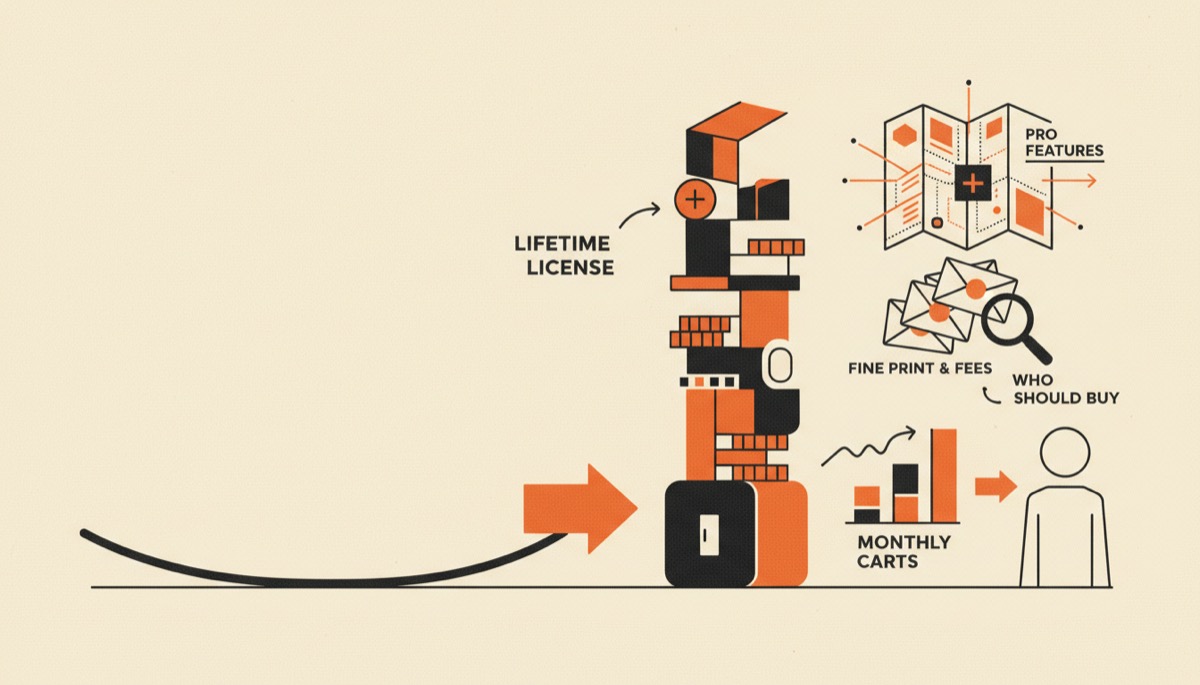
ThriveCart built its reputation on one thing: you pay once, and you own your checkout. That made the math trivially easy against carts charging $49 to $99 a month forever. The situation is more nuanced now, because ThriveCart also sells monthly and annual plans and no longer publishes the lifetime price on its pricing page.
Bottom line:
- If you can still get the lifetime license at its historical price of roughly $495, and you plan to sell digital products for more than about a year, the math strongly favors buying it.
- Monthly plans now exist at roughly $47/month for Standard and $87/month for Pro+ (less when billed annually), with a 30-day free trial.
- The Pro tier changed. The old one-time Pro upgrade has largely been replaced by Pro+ on a recurring basis, so “buy once, own forever” no longer covers the advanced features. Confirm what is on offer before you buy.
Quick comparison
| ThriveCart lifetime license | Typical monthly cart | |
|---|---|---|
| Pricing model | One-time payment, historically around $495 for Standard; price no longer published publicly | $39 to $99+/month, forever |
| Free plan / trial | 30-day free trial on the monthly plans | Usually a 7 to 14-day trial |
| Best for | Creators with a product line and a multi-year horizon | Creators testing whether they will sell at all |
| Transaction fees | 0% on sales; a small tax-processing fee applies on newer accounts when the built-in tax engine calculates or collects sales tax | 0% to 7.5% depending on platform and tier |
| Standout feature | High-converting one-page and embedded checkouts, order bumps, one-click upsells, built-in affiliate center | Varies; usually tighter integration with a single platform |
| Weakest point | Dated admin interface, and the lifetime offer is now opaque | The bill never stops |
Because ThriveCart’s structure has shifted, treat every number here as a starting point and verify on the current ThriveCart pricing page.
What ThriveCart is for
ThriveCart is a checkout and cart, not a course platform and not an email tool. Its job is the thirty seconds between “I want this” and “I bought this,” and it is very good at that job.
The core features: one-page checkouts you can embed anywhere, order bumps on the checkout itself, one-click upsells after payment, pay-what-you-want and multi-currency options, trials, split payments, subscription management, and behavior-based rules. It also includes an affiliate center and a basic course delivery product, so a small business can run on ThriveCart plus an email tool and nothing else.
You connect it to Stripe and PayPal and it settles into your own accounts. That is a meaningful difference from platforms that sit between you and your money.
The lifetime license math
The argument for a one-time fee is simple. A monthly cart at $49 costs $588 a year and $2,940 over five years. A one-time $495 costs $495.
For a creator who sells digital products continuously, this is not close. The break-even against a $49/month alternative arrives in about ten months. Everything after that is margin you keep.
The argument gets weaker in two situations.
First, if you are not sure you will still be selling in a year. A one-time fee is a bet on your own persistence. Plenty of $495 licenses sit unused in accounts belonging to people who moved on. If you have never sold a digital product, do not buy a lifetime license to find out whether you can — validate with something free first, then buy the cart.
Second, if your platform already includes a good checkout. If you run everything on Kajabi or a similar all-in-one, you are paying for a cart you are not using. Compare against your actual marginal cost, not against the sticker price of a standalone cart. Our Kajabi vs Systeme.io comparison covers what the all-in-ones already give you.
The part you need to read carefully
ThriveCart’s pitch used to be one sentence. It is not anymore, and anyone telling you it still is has not checked.
The lifetime license is no longer publicly priced. It still exists, but the pricing page routes you into a signup flow rather than showing a figure. The historical $495 for Standard still appears on some pages and in plenty of affiliate content. Do not assume it applies to you until you see it in your own checkout.
Pro changed from a one-time upgrade to a recurring tier. The advanced feature set — affiliate management at depth, multiple order bumps, custom branding, subscription tooling, higher community and video limits — now generally sits behind Pro+, which is billed monthly or annually rather than bought once. If affiliate management is the reason you wanted ThriveCart, price that separately.
“0% fees” has one asterisk. ThriveCart does not take a cut of your sales. On newer accounts, though, a small fee of roughly 0.35% to 0.5% applies when ThriveCart’s tax engine calculates or collects sales tax or verifies a VAT ID. It only triggers when the tax system is actually doing work, but it is not literally zero for everyone.
None of this makes ThriveCart a bad product. It makes the old “lifetime deal, no brainer” framing outdated, and you should evaluate it on today’s terms.
Standard vs Pro+: which features matter
Standard is a complete cart. Checkouts, bumps, upsells, subscriptions, coupons, Stripe and PayPal, basic course delivery, and behavior rules. For a creator selling a handful of products to their own list, Standard is genuinely enough.
Pro+ is worth it for three specific reasons, and only those:
- You want an affiliate program. ThriveCart’s affiliate center with automatic commission payouts is the single strongest reason to move up. If affiliates will drive real revenue, this pays for itself.
- You want multiple order bumps and deeper funnel logic. More bumps, more conditional behavior, more room to optimize average order value.
- You need the higher limits. Larger community member caps and substantially more video storage if you are delivering courses inside ThriveCart.
If none of those describe you, stay on Standard and revisit later. You can compare the current tiers side by side and see exactly which features moved where.
Where ThriveCart is weakest
The interface is dated. Functional, fast, and clearly built by people who cared about conversion rather than visual design. You will not enjoy the admin, and your customers will never see it.
Course delivery is basic. It exists, it works, and it is not a substitute for a real course platform if you need progress tracking, quizzes, certificates or a polished student experience. Compare against Teachable vs Thinkific before you commit to delivering serious curriculum inside a cart.
There is no email marketing. By design. You will need a separate email platform and a working integration, and that seam is where launches break.
Pricing transparency. A product built on the promise of a clear one-time price ought to publish that price, and the lifetime option is not shown on the public pricing page.
Who should buy ThriveCart
- You already sell digital products and expect to keep selling them for years.
- Your current platform’s transaction fee is costing you real money — a 7.5% cut on a $200 course is $15 per sale, and at 30 sales a month that is $450.
- You want to own the checkout layer independently of whichever course platform or community tool you happen to be using.
- You plan to run an affiliate program and want payouts handled for you.
- Average order value matters to you and you want bumps and upsells done properly.
For that profile, ThriveCart is one of the few purchases in this category that keeps paying you back.
Who should not
- You have not yet made a sale. Use a free checkout first, prove the offer, then buy the cart.
- You are happy inside an all-in-one that already handles payments well.
- You sell one product to a small list and your cart cost is already near zero.
- You need a polished course experience more than you need checkout optimization.
- You cannot verify the current price and terms. Never buy a lifetime license on the strength of an old blog post, including this one.
FAQ
Is the ThriveCart lifetime license still available?
Yes, but it is no longer listed with a public price. It is offered through the signup flow rather than the pricing page, so you need to check what you are actually being offered and at what price before buying.
Does ThriveCart charge transaction fees?
Not on your sales. Your own Stripe or PayPal processing fees apply as normal, and newer accounts may see a small fee of well under 1% when ThriveCart’s tax engine calculates or collects sales tax. Verify on the current pricing page.
Is Pro worth the extra cost?
Only if you want an affiliate program, multiple order bumps, or the higher community and video limits. Standard handles the core checkout job completely. Bear in mind Pro+ is now a recurring cost rather than a one-time upgrade.
Can I use ThriveCart with my course platform?
Yes, and that is the common setup: ThriveCart takes the money, your course platform or community delivers the product, and your email tool handles follow-up. Check that your specific platform supports ThriveCart-triggered enrollment before you buy.
Verdict
ThriveCart remains the best standalone checkout for creators who sell digital products, and the one-time license — if you can get it at its historical price — is still the cheapest way to own that layer for years.
Just buy it with your eyes open. Confirm the lifetime price yourself, confirm whether the features you actually want sit behind the recurring Pro+ tier, and confirm the tax-fee terms for a new account. Then, if the numbers work for your volume, check ThriveCart’s current pricing and start the trial before you commit to anything permanent.
Tools mentioned in this article
Keep reading

Kajabi vs Systeme.io: Premium or Free All-in-One?
Kajabi costs real money and removes friction. Systeme.io is free to start and asks for patience. Here is which all-in-one platform fits your stage.
Systeme.io Review: Is the Free Plan Good Enough?
An honest Systeme.io review: what the free plan includes, where the platform falls short, and which creators should use it instead of paying monthly.