Best Community Platforms for Creators, Compared
Skool, Circle and Kajabi compared for paid communities: the simplest to launch, the most brandable, and the best all-in-one. Fees and trade-offs included.
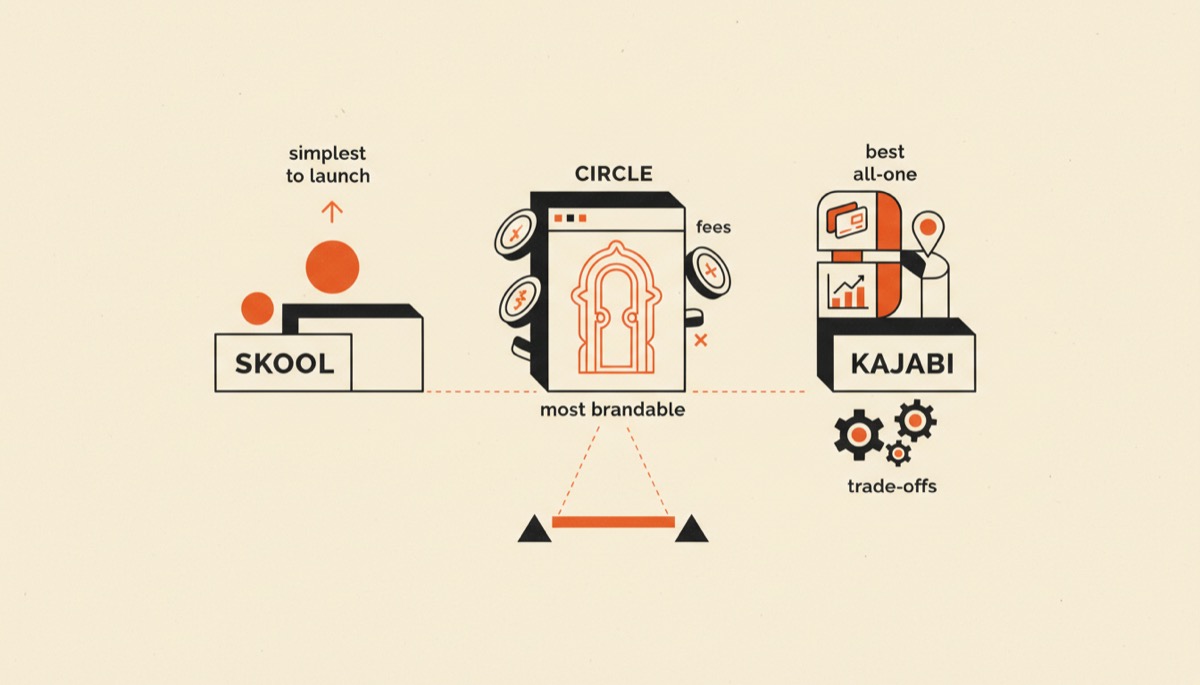
Three platforms cover almost every paid community a creator will build. Skool is the simplest to launch and the best at making members actually post. Circle is the most brandable and the only one that treats the community as infrastructure. Kajabi is the all-in-one if you already need courses, email, funnels, and checkout in one bill.
Bottom line:
- Simplest: Skool — roughly $9 or $99/month, one feed, one classroom, gamification built in.
- Most brandable: Circle — from around $89/month, custom domain, spaces, workflows, API.
- All-in-one: Kajabi — from around $89/month for Kickstarter, with courses, email, and funnels included.
Quick comparison
| Skool | Circle | Kajabi | |
|---|---|---|---|
| Pricing model | Flat per community: roughly $9 Hobby or $99 Pro per month | Tiered: around $89/month Professional, around $199/month Business, custom top tier | Tiered: Kickstarter around $89/month, Basic around $179, Growth around $249, Pro around $499 |
| Free plan / trial | Free trial, no free plan | Free trial, no free plan | Free trial, no free plan |
| Best for | First paid community, coaching groups, masterminds | Brands and memberships with multiple segments | Creators who want courses, email, funnels and community in one tool |
| Transaction fees | About 10% + $0.30 on Hobby, about 2.9% + $0.30 on Pro | Roughly 2% entry plan, about 1% mid-tier, lower on custom | Varies by plan and processor; a platform fee applies to third-party processors |
| Standout feature | Gamified leaderboard that reliably drives daily posting | Spaces, permissions, workflows, white-label options | Genuinely everything in one login |
| Weakest point | Almost no customization | High floor price, you design the architecture | Expensive, and community is the weakest module |
Prices and fee percentages change. Confirm on the Skool pricing page, the Circle pricing page, and the Kajabi pricing page before you commit to annual billing.
Simplest to launch: Skool
Skool is one screen. A community feed, a classroom for courses, a calendar, a members list. That is the entire product, and new members need no tour.
The leaderboard is the reason to take it seriously. Members earn points when their posts get liked and unlock levels as they accumulate. It sounds like a gimmick. In practice it is the single biggest reason Skool communities feel busier than their member count suggests, because the software creates a default behavior loop instead of waiting for you to run one.
The feed is also singular and chronological. There is nowhere else to post, so conversation concentrates rather than splitting across twelve half-dead channels.
Pricing is two tiers with identical features, which is unusual and honest. Hobby is around $9/month but keeps roughly 10% + $0.30 of every charge. Pro is around $99/month and keeps about 2.9% + $0.30. Features do not differ — you are buying a lower take rate.
The crossover sits around $1,200–1,300 in monthly community revenue. Below that, Hobby is cheaper. Above it, pay for Pro. Run the number rather than guessing, because a community doing $3,000/month on Hobby is donating about $200 a month for nothing.
What you give up is customization. You get a custom URL and a logo; every Skool community looks like a Skool community. For a solo coach that is arguably a benefit — the design is already tested. Full detail in our Skool review.
Most brandable: Circle
Circle is a kit rather than a finished product. You build spaces — feeds, courses, chat channels, events — group them into sections, decide which are public and which are gated, then style the whole thing to match your brand.
That flexibility is the point. Circle is the only one of the three that handles multiple audiences properly under one roof: a free front room feeding a paid inner circle, gated cohort spaces, a private space per client, permissions keeping them separate without separate communities.
Workflows matter as much as branding. Tag a member on purchase, grant space access, fire an onboarding sequence, revoke access on churn. Combined with an API, SSO, and a white-label mobile app on the top tier, Circle can be a component of a larger product rather than a destination you send people to.
The costs are real. The entry plan starts around $89/month on annual billing with no free tier, the transaction cut sits on top of Stripe processing, and the design work is yours. A Circle community with twelve spaces, three of them dead, is the classic first-month mistake — start with two.
Circle is also neutral on engagement. It will not nudge anyone into posting. See the Circle review for the full picture, and Skool vs Circle for the head-to-head.
Best all-in-one: Kajabi
Kajabi is not primarily a community platform. It is a creator business platform where community is one module alongside courses, email marketing, funnels, landing pages, checkout, and a website.
That framing tells you exactly when to choose it. If you are already paying for a course host, an email tool, a page builder, and a cart, Kajabi replaces the stack with one bill and one login, and the community comes along free. If you only want a community, you are buying four products to use one.
Pricing runs from around $89/month for Kickstarter up through roughly $179 Basic, $249 Growth, and $499 Pro on monthly billing, with annual billing meaningfully cheaper. Contact and product limits differ by tier, and a platform fee applies if you process payments through a third party rather than Kajabi’s own checkout — worth checking before you assume your existing Stripe setup is free to keep.
Be clear-eyed about the community module itself: it is competent, not best-in-class. No leaderboard psychology like Skool, less structural flexibility than Circle. What it has is zero integration work — a purchase grants course access and community access in the same transaction, with no workflow to wire up.
Compare it against the simpler stack in Kajabi vs Systeme.io and against a pure course host in Kajabi vs Teachable.
The fee math that decides it
Sticker price is the smaller number. Use this:
Monthly fee + (transaction % × monthly community revenue) + payment processing
At $2,000/month in community revenue: Skool Hobby costs roughly $9 + $200 = $209. Skool Pro costs roughly $99 + $58 = $157. Circle’s entry plan costs roughly $89 + $40 = $129 before its higher base is offset by the lower cut. Kajabi depends on plan and processor.
Two things to remember. These platform fees sit on top of normal Stripe processing, not instead of it. And you can often avoid platform transaction fees entirely by billing through an external checkout and using the community only for access — more moving parts, but it is how many larger operators run it, and a one-time-fee cart pays for itself quickly at volume.
Pick in 30 seconds
- First paid community, want it live this week, engagement is your worry → Skool.
- Existing brand, multiple segments, needs to integrate with your stack → Circle.
- Already need courses, email, funnels and checkout too → Kajabi.
- Community is a bonus on a course you are selling → whichever platform hosts the course.
If you are still choosing where the course itself lives, start with the best online course platforms before you pick a community tool.
FAQ
Do any of these have a free plan?
No. All three offer free trials and then require a paid plan. If you need to validate a paid offer before spending anything, run a waitlist with an email tool and a simple sales page, then open the community once you have committed buyers.
Which platform is best for engagement?
Skool, by a clear margin, because the leaderboard and single feed create posting behavior by default rather than relying on your moderation. Circle and Kajabi can both be lively, but the liveliness comes from your programming, not the software.
Can I move a community between platforms later?
Members and course content can be recreated, but discussion history generally does not transfer cleanly. That archive of conversation is the asset that made the community valuable, so treat the choice as semi-permanent and pick for where you expect to be in a year.
Is it cheaper to bill outside the platform?
Often, yes. Using an external checkout and granting access manually or by webhook avoids the platform transaction cut, leaving only payment processing. It adds a failure point and some setup, so it makes sense past roughly a few thousand dollars a month in community revenue, not before.
What we would do
Launching your first paid community with no brand equity: start a Skool trial, pay for Pro once revenue passes about $1,300 a month, and spend your energy programming the first 30 days instead of designing anything.
Adding a community to an established business with a list and existing products: start with Circle, build exactly two spaces, and wire purchases to access before you invite anyone.
Replacing four subscriptions at once: look at Kajabi and price it against what you currently pay in total, not against Skool’s $9.
Tools mentioned in this article
Keep reading
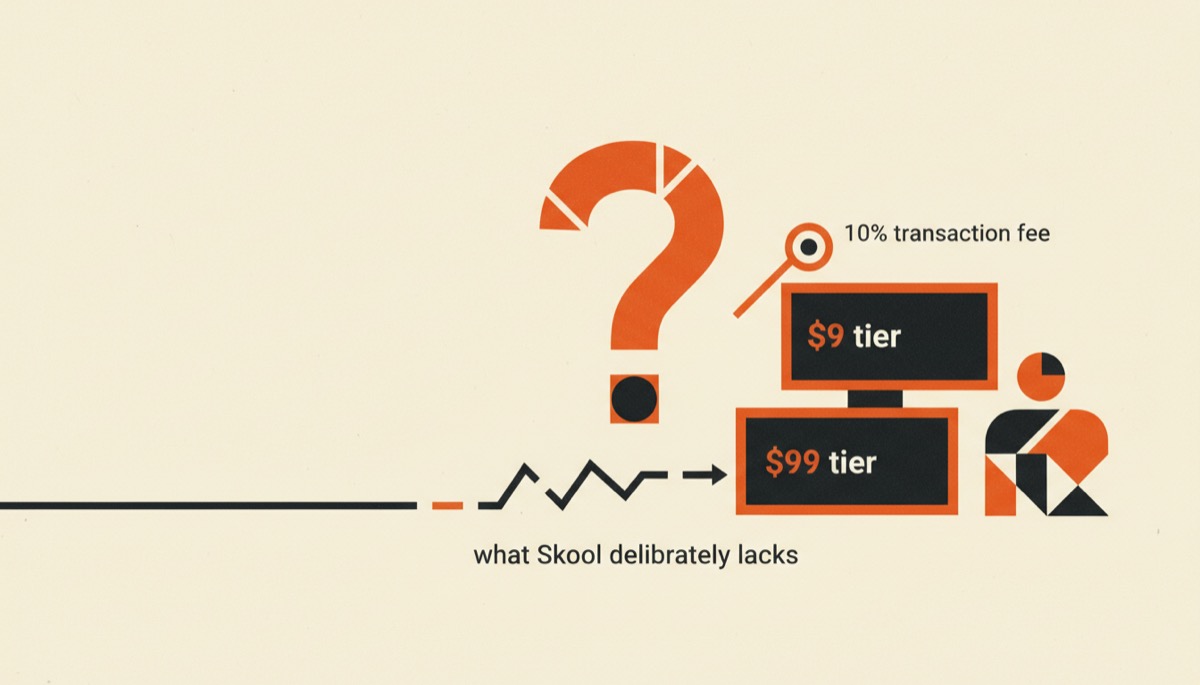
Skool Review: Two Plans, One Big Fee Question
An honest Skool review of the $9 and $99 tiers, the 10% transaction fee on the cheap plan, what Skool deliberately lacks, and who it actually fits.

Circle Review: Is a Branded Community Worth $89?
Circle is the most brandable community platform for creators, and the priciest. Here is what you get for the money, and who should skip it.
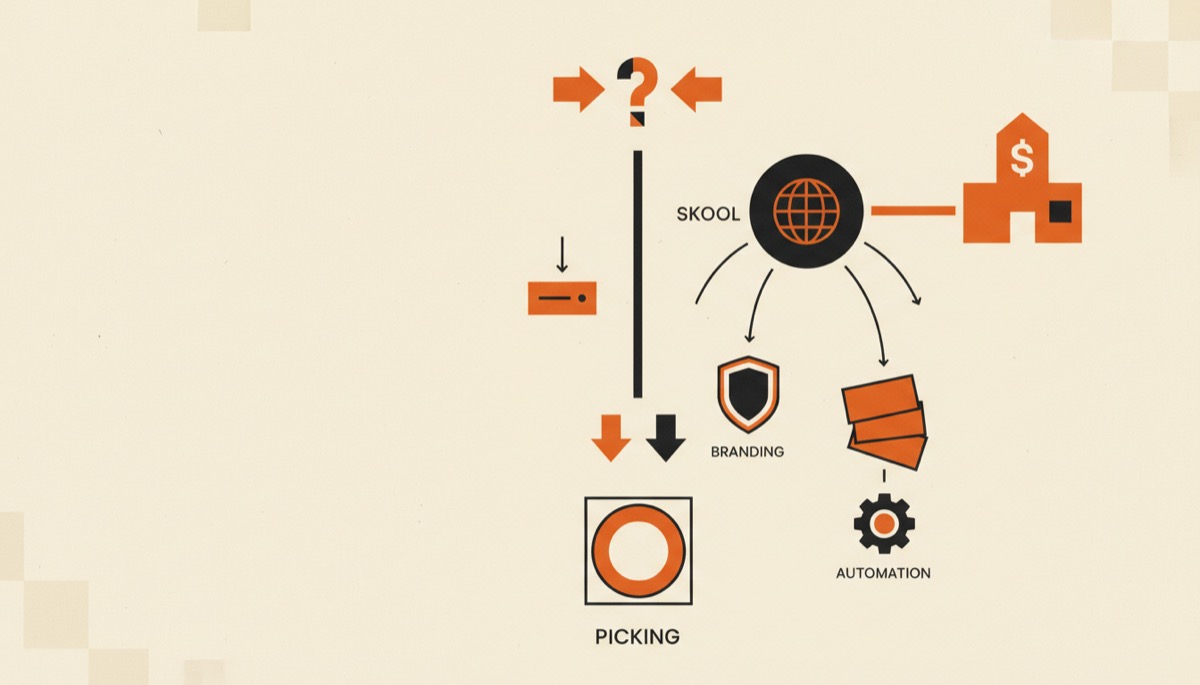
Skool vs Circle: Which Community Platform Wins?
Skool keeps paid communities dead simple. Circle gives you branding, spaces and automation. Here is how to pick the right one for your members.