Skool Review: Two Plans, One Big Fee Question
An honest Skool review of the $9 and $99 tiers, the 10% transaction fee on the cheap plan, what Skool deliberately lacks, and who it actually fits.
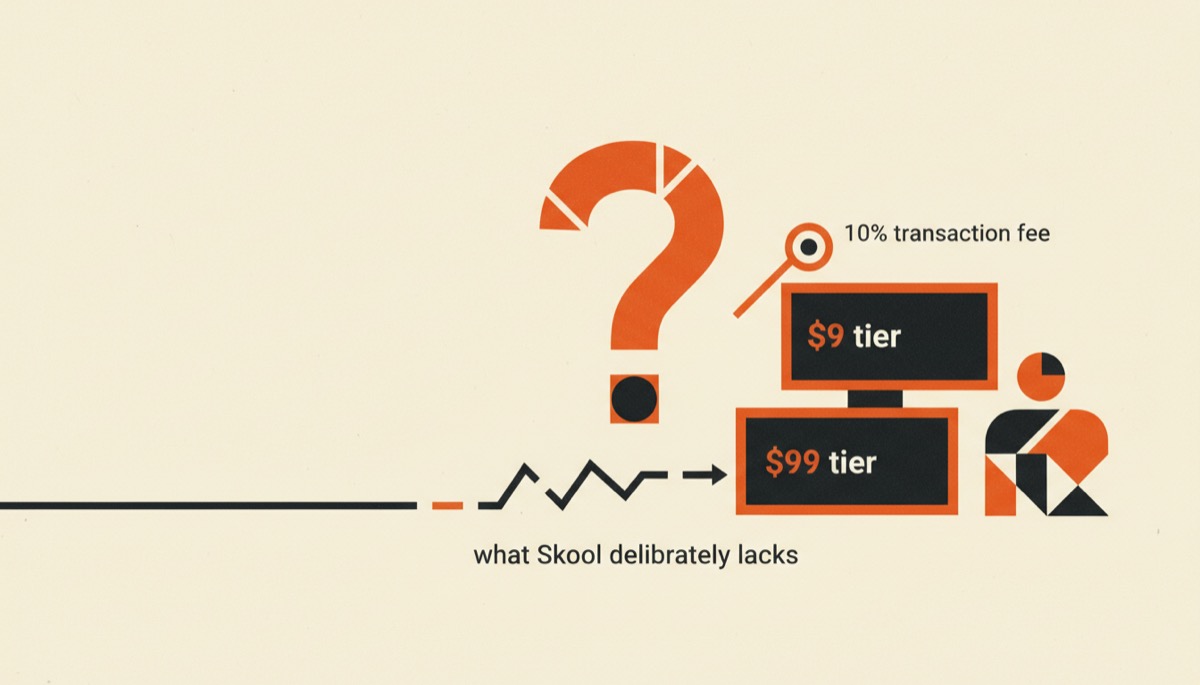
This Skool review starts with the trade nobody explains clearly: the $9 plan takes 10% of every payment your members make, and the $99 plan takes 2.9%. Everything else about Skool is the same on both.
So the pricing question is not “can I afford $99.” It is “at what revenue does 10% cost more than $90 a month.” The answer is around $1,300 in monthly member payments.
Bottom line
- Hobby: around $9/month ($7.50 annual) with a 10% plus 30 cents fee on every transaction.
- Pro: around $99/month ($82 annual) with the fee dropping to 2.9%.
- Skool is the best simple paid-community product on the market and a deliberately thin course platform. Both are on purpose.
The two tiers, and where the line falls
| Hobby | Pro | |
|---|---|---|
| Monthly | around $9 | around $99 |
| Annual | around $7.50/month | around $82/month |
| Transaction fee | 10% plus 30 cents | 2.9% |
| Features | Full platform | Full platform |
| Trial | 14 days, no card | 14 days, no card |
Confirm current numbers on the Skool pricing page before you plan around them.
Read the features row again. Skool does not gate functionality behind the expensive plan. Both tiers get the community, courses, calendar, gamification, member management and payments. You are buying a lower transaction fee, nothing else.
That is unusually honest for this category and it makes the math simple.
The price difference on annual billing is roughly $75/month. The fee difference is about 7 percentage points. Seventy-five dollars at 7% arrives at roughly $1,070 in monthly member payments; on monthly billing the crossover sits closer to $1,300.
Under that, Hobby is genuinely cheaper. Over it, you are donating money. A community with 30 members at $49/month is collecting $1,470 — comfortably past the line, and paying about $147 a month in fees on Hobby versus $82 plus $43 on Pro.
Check this every few months. It is the single easiest saving in your stack and almost nobody revisits it.
What Skool gets right
One feed, no navigation. Skool’s whole design philosophy is that members should never wonder where to post. There is a community feed, a classroom tab, and a calendar. That is it. Compared with platforms that give you spaces, sub-spaces, channels and threads, engagement per member tends to be higher simply because there is nowhere to get lost.
Gamification that actually works. Members earn points for likes on their posts, and points unlock levels. It sounds gimmicky. It produces measurably more posting, because people who contribute get visible status. This is Skool’s most copied feature for a reason.
Courses bundled in. Every plan includes a classroom where you can publish modules and lessons, gate them by level, and deliver them to members. For a community-first offer with a course attached, you need nothing else.
Payments built in. Recurring subscriptions, one-time payments, free trials and annual billing are native. You do not add a cart.
Discovery. Skool runs a public directory where people browse paid communities by topic. Most platforms give you zero distribution. This gives you a little, which is more than zero.
It is fast and it does not break. The app is light, the mobile experience is good, and there is nothing to configure. Setup is measured in minutes rather than evenings, which matters more than any feature list when you are trying to launch before your motivation runs out.
Calendar and events. Group calls, office hours and cohort start dates live on a shared calendar that members can add to their own, so attendance does not depend on someone reading a post in time.
What Skool deliberately lacks
Design control. You get a cover image, a name and a description. No custom CSS, no theming, no layout options, no white-labeling. Every Skool community looks like a Skool community. If your brand needs to own the experience, this is disqualifying and no plan fixes it.
Course delivery depth. Modules, lessons, video, level gating. No quizzes, no certificates, no graded assignments, no drip by date, no completion tracking worth the name. Skool’s classroom is a content library, not a learning management system. Anyone selling a credential should deliver it elsewhere — see best online course platforms.
Email marketing. You can post announcements and email members. There is no sequence builder, no segmentation, no automation. Run a real email platform alongside it.
Analytics. Thin. Member counts, activity, basic revenue. No cohort retention analysis, no funnel reporting, no content engagement breakdown.
Spaces and structure. The single-feed design is a strength for a 200-person community and a weakness for a 5,000-person one, where topic separation genuinely helps. Categories exist but they are light.
Integrations. A small API and a limited integration surface. If your stack depends on data flowing in and out automatically, expect to build it yourself or do without — Circle is the stronger choice there.
None of this is an accident. Skool’s founders removed features on purpose, and the simplicity is the reason engagement holds up. It is a real trade, not a roadmap gap.
Who should use Skool
- You are selling a paid community where the members talking to each other is the product.
- You have a course but it is the bonus, not the offer.
- You want to launch this week with no configuration and no design work.
- Your community is under a few hundred members, where one feed still feels alive.
- You coach a group and want calls, discussion and materials in one cheap place.
Start a Skool trial on Hobby, launch, and move to Pro the month your member payments clear roughly $1,300.
Who should skip it
- Your brand requires a custom look or white-labeling.
- The course is the product and students need quizzes, certificates or graded work.
- You are running a large community that needs real topic separation and moderation tooling.
- You need deep integrations, automation or analytics.
- You want a free tier. Skool has a 14-day trial and nothing free after it.
FAQ
Is the 10% fee on top of card processing?
The 10% plus 30 cents on the Hobby plan is Skool’s all-in charge for handling a transaction, and the Pro plan reduces it to 2.9%. Because Skool bundles payment processing rather than putting a platform cut on top of Stripe’s, treat those numbers as your total cost per payment and verify on the pricing page before you model it.
Does Skool have a free plan?
No. Both tiers include a 14-day trial with no credit card required, and after that you are paying. For a genuinely free way to run a community alongside a course, look at an all-in-one like Systeme.io, covered in our Systeme.io review.
Can I use Skool as my only course platform?
Only if your course is simple video and text. There are no quizzes, certificates or graded assignments, and progress tracking is minimal. Community-first offers can absolutely live entirely on Skool. Credential-style courses cannot.
Skool or Circle?
Skool for engagement and simplicity at a low price. Circle for branding, structure, integrations and larger communities. Full comparison in Skool vs Circle.
Our verdict
Skool is the rare product that is better because of what it refuses to do. If you are selling access to a group of people rather than a curriculum, it will outperform platforms with five times the feature list, and the $9 tier makes starting almost free of risk.
Start on Hobby, because the fee is cheaper than the subscription until you have real revenue. Open a Skool trial, get ten paying members in, and set a reminder to run the fee math again at the end of the quarter. If your brand or your curriculum needs more than Skool allows, that is not a flaw to wait out — pick a platform built for it and stop shopping.
Tools mentioned in this article
Keep reading
Best Community Platforms for Creators, Compared
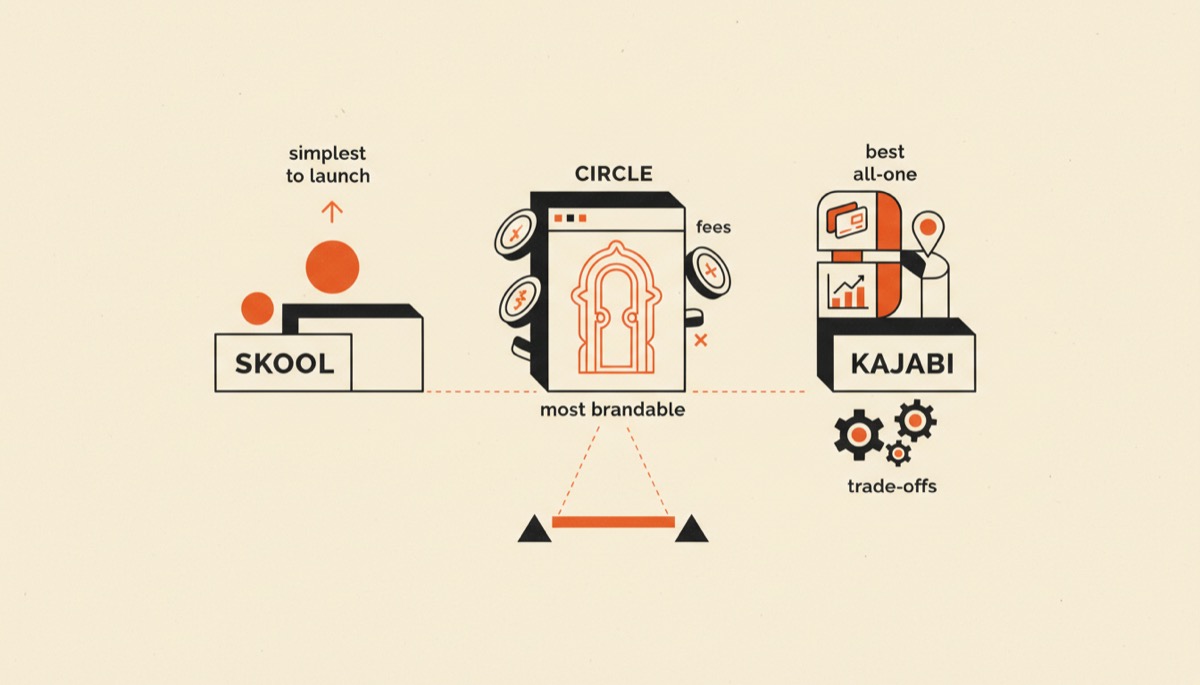
Skool, Circle and Kajabi compared for paid communities: the simplest to launch, the most brandable, and the best all-in-one. Fees and trade-offs included.

Circle Review: Is a Branded Community Worth $89?
Circle is the most brandable community platform for creators, and the priciest. Here is what you get for the money, and who should skip it.
Skool vs Circle: Which Community Platform Wins?
Skool keeps paid communities dead simple. Circle gives you branding, spaces and automation. Here is how to pick the right one for your members.