Kajabi Review: Worth the Price, or Overkill?
An honest Kajabi review: what the all-in-one price really buys, which creators get their money back, and who should pick something cheaper instead.
Short version of this Kajabi review: Kajabi is worth the money if it replaces three or four paid tools you already use and you are selling consistently. It is overkill if you have not made your first sale, because you will pay premium platform prices for an audience you do not have yet.
Kajabi is not expensive for what it does. It is expensive for what most people use it for.
Bottom line
- One login covers courses, email, landing pages, checkout, a community and a mobile app. Nothing to integrate.
- No free plan and no cheap entry tier. Price is the main objection and it is a fair one.
- Best for creators past roughly $3,000/month who are tired of stitching tools together. Worst for validation.
What you are actually paying for
Kajabi sells consolidation, not any single best-in-class feature.
In one account you get course hosting, a digital product store, coaching products, a landing page and website builder, email marketing with automations, a checkout with upsells and order bumps, a community area, an affiliate program, analytics, and a branded mobile app for your members.
Priced separately, that stack is a course platform, an email platform, a page builder, a community tool and a cart. Realistically $150 to $250 a month, plus the hours you spend making them talk to each other.
That is the entire pitch. If you value the seams disappearing, Kajabi is rational. If you do not have enough moving parts for seams to exist, you are buying insurance against a problem you do not have.
Pricing, honestly
Kajabi does not publish a cheap on-ramp the way its rivals do, and it reshuffles its plan lineup more often than most.
Depending on which signup path you land on, the lowest tier runs somewhere around $69 to $89/month on annual billing. The mainstream tiers climb from roughly $140/month annual up past $400/month for the top plan, with monthly billing costing about 20% more than annual across the board.
Do not plan around any of those figures without confirming them on the Kajabi pricing page. Treat what you read anywhere, here included, as a starting point.
Two things are stable and worth knowing.
First, there is no free plan. There is a trial, and the length varies by signup path. Second, Kajabi takes no platform cut of your sales on any plan. You pay ordinary card processing of roughly 2.9% plus 30 cents and nothing else. That matters more than it sounds, because several cheaper platforms claw back their low price with a percentage of every transaction.
The entry tiers are also tightly capped on products and contacts. If your plan is one course and a small list, a cheap plan works. If your plan is a product catalog, you are on a mid tier before you finish building.
Where Kajabi earns its money back
Email that is actually good enough to be your only email tool. This is the feature that separates Kajabi from most course platforms. Broadcasts, sequences, visual automations, segments and tagging that react to purchases and course progress. Most bundled email inside a course platform is a receipt engine. Kajabi’s is a real marketing tool. It is not as deep as a dedicated platform, but it is close enough that most creators never need one.
Checkout and offers. Order bumps, upsells, payment plans, trials, coupons and multi-product offers are native. Building a $47 tripwire that upsells a $497 course takes an afternoon, not a project.
The branded mobile app. Your members get a real app with your name on it and push notifications. For a membership or a community-heavy program, retention improves when people stop having to remember a login in a browser tab.
Automations across the whole business. Because email, courses, community and checkout live in one database, a trigger in one place can act anywhere. Completed module three, tag them, send the upsell. No webhook to debug at 11pm.
It holds together. Kajabi’s real product is reliability under launch traffic and one support team who can see your whole setup. Underrated until the day you need it.
Where Kajabi falls short
Price at the starting line. There is no honest argument for paying Kajabi’s rates before you have proof someone will buy. Validate somewhere cheap, then move.
Page builder. Competent, template-driven, not exciting. You can build a good-looking sales page. You will not build something that makes a designer look twice. Fine for most, frustrating if pages are your brand.
Community is adequate, not a destination. It is a place for members to post. It is not Circle or Skool. If community engagement is the core product rather than a bonus, run it elsewhere — see Skool vs Circle.
Course delivery is average. Modules, lessons, video, drip, quizzes, basic assessments. No interactive video, no serious white-labeling on lower tiers, thin on cohort features. Platforms like LearnWorlds and Thinkific beat it on pure teaching depth.
Blogging and SEO. Weak. If organic search is your acquisition channel, run a real site alongside and use Kajabi for delivery and checkout.
Migration friction. All-in-one cuts both ways. Everything in one place means everything leaves at once, which is a genuinely miserable weekend if you outgrow it.
Who Kajabi is worth it for
- You are doing $3,000/month or more and currently pay for four or five separate tools.
- Your business is a course plus a membership plus coaching, and they share one audience.
- You run launches with email sequences, upsells and deadlines, and you want that in one system.
- You would rather pay more and stop being your own integrations engineer.
- You want a branded app for members without building one.
If that is you, the price stops being the story about a month in. Start a Kajabi trial and see how much of your stack it absorbs.
Who should pick something else
- You have not sold anything yet. Validate on a free or cheap platform first — Systeme.io has a free plan and exists precisely for this.
- You sell one course and send occasional emails. You are paying for nine features to use two. Thinkific or Teachable will do the job for a fraction of the price.
- Your pages or your learner experience need to look premium and custom. Look at LearnWorlds instead, compared in LearnWorlds vs Kajabi.
- Community is the product. A dedicated community platform will beat Kajabi’s.
- Your budget is genuinely tight. Nothing about Kajabi rewards being squeezed, and a cheaper platform running well beats a premium one you resent paying for.
The three alternatives we send most Kajabi shoppers to
| If your blocker is… | Pick | Why |
|---|---|---|
| The monthly price | Systeme.io | Free plan, courses + email + funnels included, no transaction fee |
| You only need courses | Thinkific | Strong course builder, free plan to start, no transaction fee on paid plans |
| You want a premium learner experience | LearnWorlds | Interactive video, better-looking course player and site builder than Kajabi |
FAQ
Does Kajabi have a free plan?
No. There is a trial, and its length depends on which signup path you use, but there is no free forever tier. If free is a requirement, Kajabi is not your platform and no amount of searching will change that.
Does Kajabi take a percentage of my sales?
No platform fee on any plan. You pay your payment processor the usual card rate, roughly 2.9% plus 30 cents on US cards. That is a real advantage over cheaper platforms that charge a transaction fee on their entry tiers.
Is Kajabi’s email good enough to cancel my email tool?
For most creators, yes. Segments, tags, visual automations and behavior triggers tied to purchases and course progress cover normal launch and nurture work. If you run a large daily newsletter or need deep deliverability control, keep a dedicated platform and let Kajabi handle products.
Kajabi or Teachable?
Teachable is cheaper and narrower; Kajabi is pricier and replaces more tools. If cost is the deciding factor, Teachable wins. If the number of subscriptions you manage is the deciding factor, Kajabi does. We break it down in Kajabi vs Teachable.
Our verdict
Kajabi is a good product at a price that only makes sense once you have revenue to consolidate. Buy it to replace a stack, never to start one.
If you are already paying for a course platform, an email tool, a page builder and a cart, put a real offer inside a Kajabi trial this week and count what you can cancel. If that number is three or more, the decision makes itself. If it is zero, keep your money and come back when you have sales to simplify.
Tools mentioned in this article
Thinkific
Course platform with a 30-day free trial and generous starter tier
course platformsTry ThinkificKeep reading
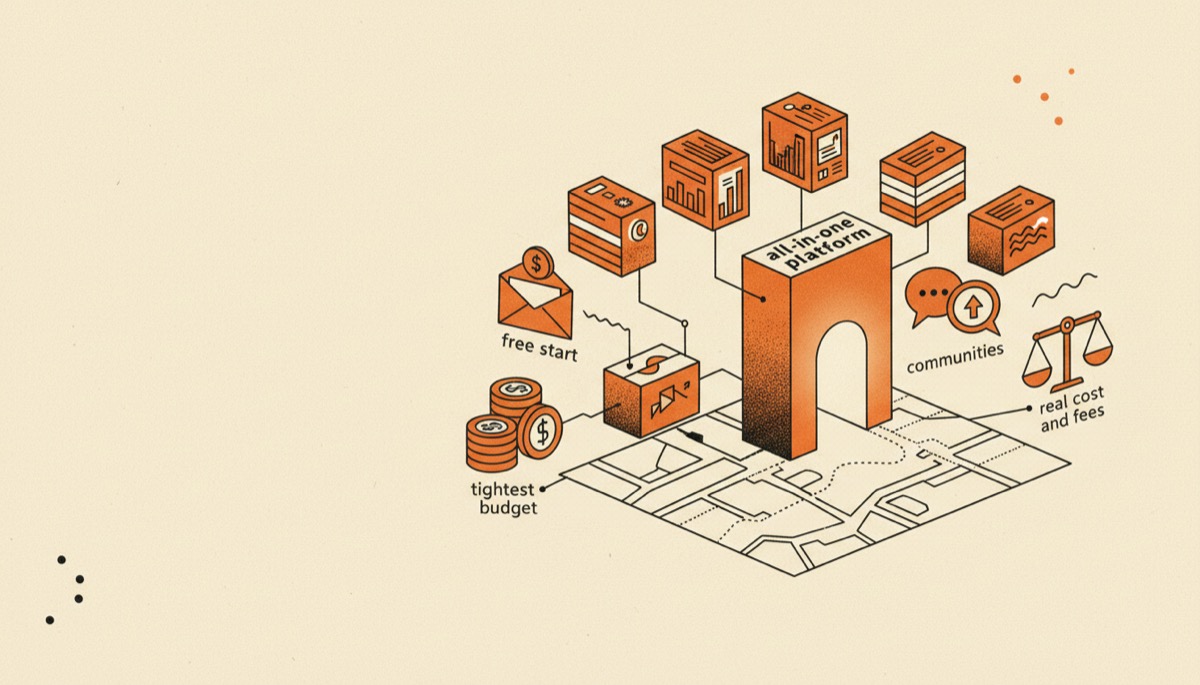
Best Online Course Platforms for Creators
Seven course platforms compared by real cost and fees, with a clear pick for a free start, all-in-one, communities, coaching and the tightest budget.
Kajabi vs Teachable: Is All-in-One Worth the Price?
Kajabi costs several times what Teachable does. Here is exactly what the extra money buys, and the revenue level where it starts paying for itself.
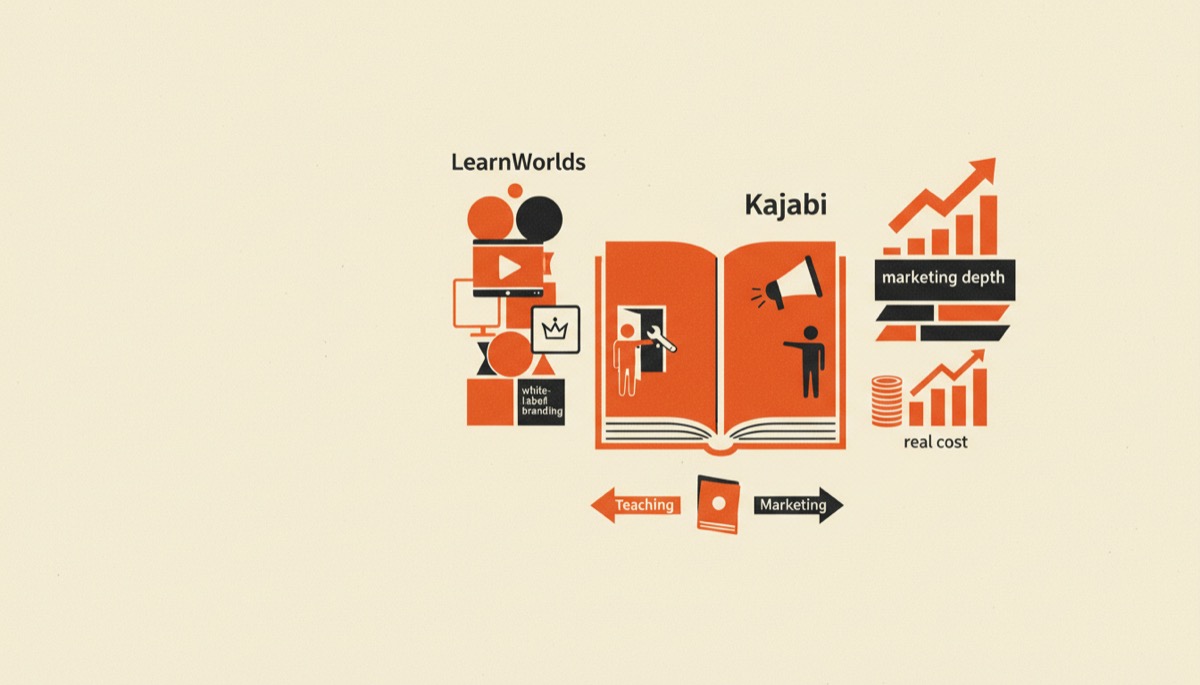
LearnWorlds vs Kajabi: Teaching or Marketing?
LearnWorlds vs Kajabi compared on white-label branding, interactive video, marketing depth and real cost, with a clear answer for each type of creator.
Podia Review: A Simple Storefront for Courses and Downloads
Honest Podia review: pricing, the 5% fee on the entry plan, what it does well for courses and downloads, and when Teachable or Systeme.io fits better.