Printify vs Printful: Which POD Partner Is Better?
Printify vs Printful on margins, print quality, shipping speed, branding and support. Which print-on-demand partner fits your store and your budget.
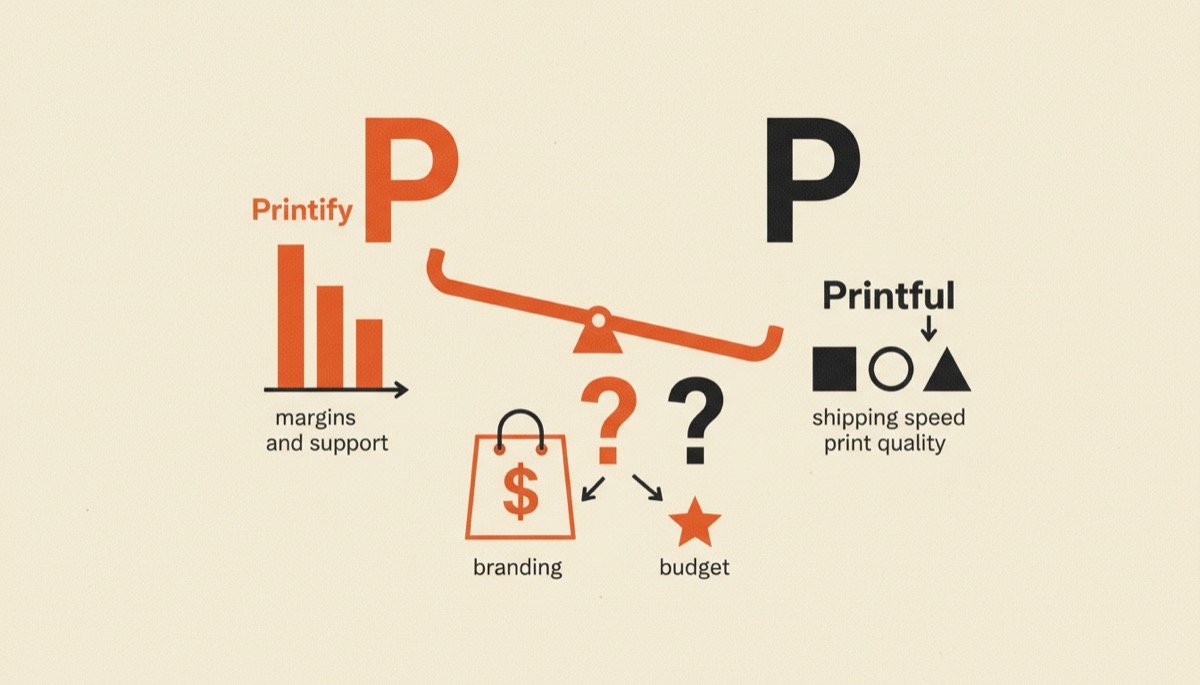
Printify vs Printful is a choice between a marketplace and a factory. Printify is a network of independent print providers you select from, which usually means lower base costs and more variation. Printful owns and operates its fulfillment, which usually means higher base costs and more consistency.
Bottom line:
- Pick Printify for margin. More providers competing on the same blank means cheaper base costs and more product choices.
- Pick Printful for consistency and brand control. One operator, one quality standard, stronger branding options.
- If your product is merch attached to an audience that trusts you, consistency is worth more than a dollar of margin.
Printify vs Printful compared
| Printify | Printful | |
|---|---|---|
| Fulfillment model | Marketplace of independent print providers worldwide; you choose per product | In-house owned and operated facilities |
| Pricing model | Free to use; optional Premium subscription (recently around $39/month monthly, cheaper annually) for catalog discounts | Free to use; optional Growth plan (around $24.99/month) for product and branding discounts |
| Base product cost | Generally lower, and varies by provider for the same blank | Generally higher, consistent across the catalog |
| Catalog size | Very large — thousands of items across many providers | Smaller and more curated |
| Branding options | Varies by provider; inside labels and inserts are inconsistent | Strong and consistent — custom labels, packing inserts, custom packaging |
| Standout feature | Provider choice: compare price, location, and rating per product | Quality control and support you can escalate to one company |
| Weakest point | Quality and turnaround depend on which provider you picked | Thinner margins unless you price above the market |
Both companies have changed subscription pricing more than once. Verify current numbers on the Printify pricing page and the Printful pricing page before you build your margin model.
The margin math, honestly
Take a standard unisex tee. Printify base costs typically land a few dollars below Printful for a comparable blank and print, and Printify’s discount subscription cuts catalog prices further (up to around 20% off, more on newer products). Printful’s Growth plan does something similar — up to roughly a third off products on paper, plus branding and sample discounts, and Printful waives the subscription for a year once your annual store sales pass about $12,000.
Here is what that means in practice:
- At low volume (under ~30 orders/month), neither subscription pays for itself. Stay on the free tier of whichever you choose.
- At medium volume, both subscriptions become clearly worth it, and the comparison tightens considerably. Printify’s raw base cost edge shrinks once Printful’s Growth discounts apply.
- At high volume, you are negotiating shipping and probably splitting products between providers anyway.
The cheaper platform is rarely the more profitable one. Two things destroy POD margins far faster than a $3 base cost difference: shipping cost on the first item and reprints from quality complaints. Model those before you pick on base price alone.
Print quality and consistency
Printful’s advantage here is structural, not magical. Because Printful runs its own facilities, the same product ordered in January and June should come out the same. Color profiles, DTG settings, and QC live under one roof, and when something is wrong there is one company accountable.
Printify’s quality is genuinely good — when you pick a good provider. The catalog includes top-rated providers that match anyone on output, and Printify publishes provider ratings and production times. But you have to actually use that information. A poorly chosen provider on Printify produces the bad reviews people blame on “print-on-demand” as a category.
Practical rule for Printify: order samples from your specific provider, not from Printify generally. Then lock that provider for that product and do not let automatic routing move you without checking.
Shipping speed and where your customers live
Printify’s provider network spans many countries, so if you sell mostly to the US you can pick a US provider and ship domestically; if you sell to the EU, pick an EU provider. This flexibility is Printify’s underrated strength.
Printful has facilities across North America, Europe and partner locations, and routes orders to the closest one automatically. Less control, less thinking required.
For heavy international selling, neither is the specialist — a network built specifically around local production may beat both. We compare that directly in Gelato vs Printful.
Fulfillment time on both typically runs a few business days before the carrier takes over, varying by product type — embroidery and all-over print take longer than DTG tees. Set your store’s shipping expectations from the provider’s stated production time plus carrier transit, then add a buffer. Under-promising is how you avoid support tickets.
Branding and the repeat-purchase problem
If you sell merch to an audience that follows you — a course community, a newsletter list, a YouTube channel — the unboxing matters more than the margin. A generic poly mailer with someone else’s packing slip is a missed impression.
Printful is stronger here and it is not close: consistent inside labels, custom packing inserts, and packaging options, all applied predictably because one company is doing the printing. If you want the product to feel like yours, that consistency is the whole game.
On Printify, branding options exist but vary by provider. Some support inside labels, some do not; inserts are inconsistent. Workable, but you have to verify per provider and per product.
This is usually the tiebreaker for creators. A template seller or course creator adding merch is not running a margin-maximizing commodity store — they are extending a brand. See how to start selling online courses for where merch fits in a creator product line.
Integrations and day-to-day workflow
Both integrate with the platforms you would expect: Shopify, Etsy, WooCommerce, eBay, Wix, Squarespace, plus API access. Both push orders automatically, sync tracking, and handle variants.
Differences that show up after a month of real use:
- Printify’s mockup and catalog browsing is fast, and the provider comparison view is genuinely useful — price, location, production time, rating side by side.
- Printful’s product editor and mockup quality is more polished, and its design tools handle placement details (sleeve prints, inside labels, all-over patterns) with fewer surprises.
- Support. Printful’s is first-party and escalatable. Printify’s routes between Printify and the provider, which adds a step when something goes wrong.
Neither is hard to learn. Both take an afternoon.
Who should pick Printify
Pick Printify if:
- Margin is the constraint — you are selling into a price-sensitive market or competing on a marketplace like Etsy.
- You want the widest possible catalog, including niche products Printful does not carry.
- You are willing to sample, compare providers, and manage that choice deliberately.
- You want to control which country an order prints in.
Printify rewards operators. If you treat provider selection as a real decision rather than a default, you get better prices and comparable quality.
Who should pick Printful
Pick Printful if:
- Your merch represents a brand people already trust, and a bad print costs you more than it costs you in dollars.
- You want consistent branding — labels, inserts, packaging — without auditing it per product.
- You would rather have one accountable company than the cheapest line item.
- You are starting out and want fewer decisions between you and a live store.
Printful costs more per unit and gives you back predictability. For most creator-adjacent stores, that is the correct trade.
FAQ
Can I use both Printify and Printful?
Yes, and plenty of stores do — Printful for core branded apparel, Printify for products Printful does not carry or where margin is tight. Both plug into the same store platforms simultaneously. The cost is operational: two dashboards, two support paths, two quality baselines.
Do I need the paid subscription?
Not to start. Both platforms are free to use and you pay per order. The subscriptions pay off at volume — run the math on your actual monthly order count against the discount percentage before subscribing, and remember Printful waives Growth for a year once your annual sales pass roughly $12,000.
Which has better profit margins?
Printify generally has lower base costs, so higher margin at the same retail price. But Printful’s Growth discounts narrow the gap, and reprints from quality issues can erase it entirely. Margin on paper and margin after refunds are different numbers.
How do I avoid bad prints?
Order samples of every product from the exact provider that will fulfill it, check your artwork at full print resolution (300 DPI at actual print size), and avoid designs that depend on precise color matching or fine detail in DTG. Most POD quality complaints trace back to the artwork file, not the printer.
Where to start
If you are launching merch behind an audience and want it to look like a real brand from order one, start with Printful — free to use, consistent output, branding that holds up.
If you are optimizing for margin or need a product Printful does not stock, start with Printify, pick a top-rated provider in your customers’ region, and order a sample before you list anything.
Either way: sample first, list second. That one habit prevents most of the problems people blame on print-on-demand.
Tools mentioned in this article
Keep reading
Best Print-on-Demand Companies for Creators
The best print-on-demand companies compared on margins, print quality and global shipping, with a clear pick for each type of creator store.
Gelato vs Printful: Best POD for Global Shipping?
Gelato vs Printful for international selling: local production networks, shipping times, customs, product range, and which one fits your order map.
How to Start a Print-on-Demand Business
A step-by-step plan to start a print-on-demand business: pick a niche, make designs, choose a supplier, launch a store and price for real profit.